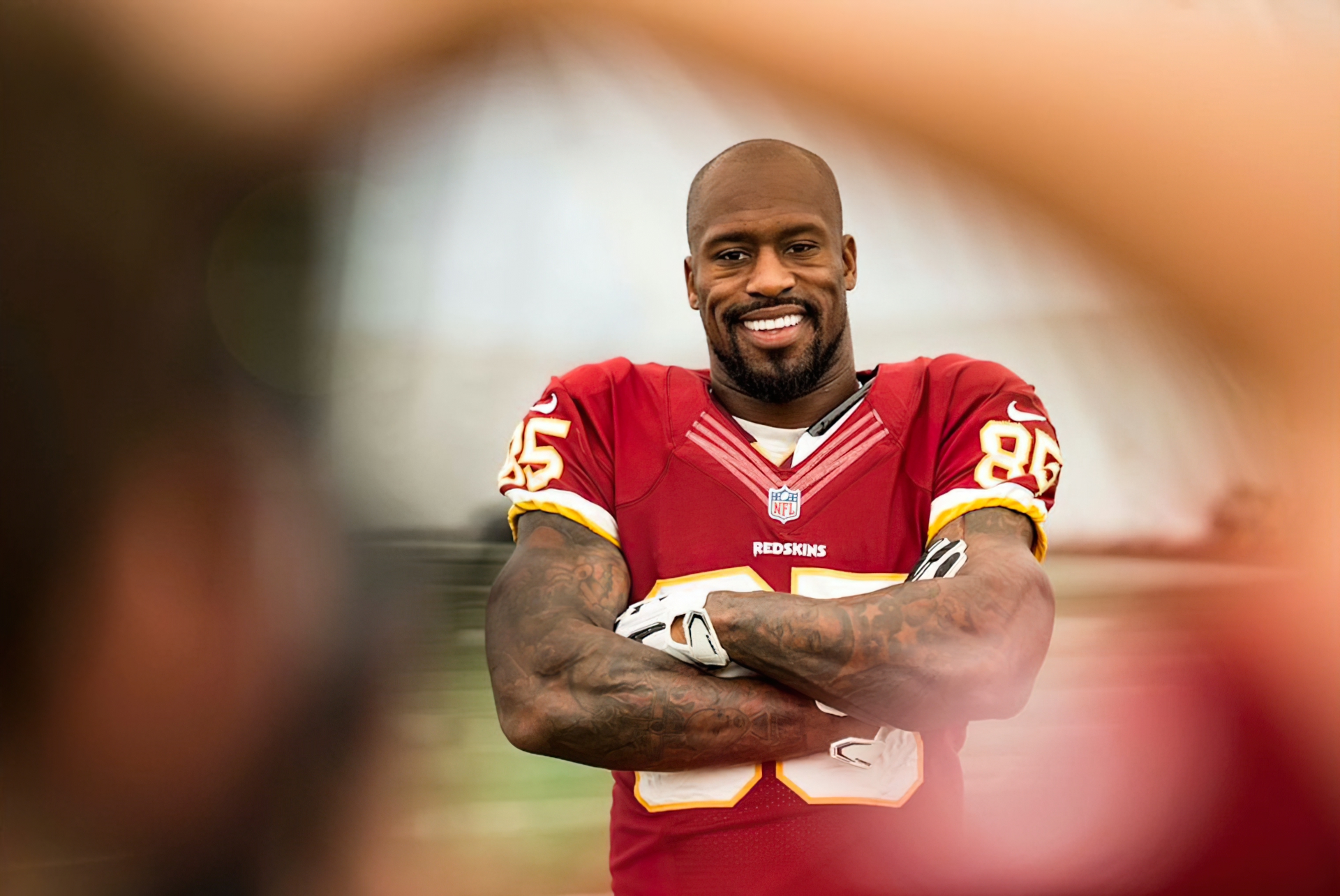
Give an NFL offensive coordinator a 254-pound tight end who runs a 4.38-second 40-yard dash, and chances are he won’t have much trouble finding something for him to do. Vernon Davis was that guy 20 years ago, and after a 14-year career that included his final four seasons with the Washington Redskins, he believes he’d be even harder to defend if he entered the league today.
We recently spoke with Davis about a variety of topics, including how much the tight end position has changed since the San Francisco 49ers selected him sixth overall in the 2006 NFL Draft. One of the more interesting questions was how he thought an offensive coordinator would use a 22-year-old version of himself in today’s game. His answer wasn’t particularly surprising, considering the numbers he put up during his career.
“I’d be a matchup problem every single week,” Davis said. “They’d move me all over the formation and force defenses to decide how they wanted to cover me. If you put a linebacker on me, I’d take advantage of the speed. Put a safety on me, I’d use my size. The goal would be simple: create mismatches and get the ball in my hands.”
It’s difficult to argue with that assessment. At the 2006 NFL Scouting Combine, the former Maryland standout didn’t just run a 4.38; he also recorded a 42-inch vertical jump and managed 33 bench-press repetitions. Those are impressive numbers for any position, but for a tight end weighing more than 250 pounds, they were something else entirely. The 49ers apparently agreed, making him the first tight end off the board that year.
Of course, Davis didn’t invent the idea of a tight end becoming a major receiving threat. Tony Gonzalez had already caught 102 passes for 1,258 yards in 2004, and Antonio Gates was making plenty of noise with the Chargers. What Davis brought was a different combination of size and speed, something that would eventually help him catch 78 passes for 965 yards and 13 touchdowns in 2009. Four years later, he reached that same touchdown total on just 52 receptions, averaging 16.4 yards per catch.
Those weren’t exactly the numbers of a player whose only job was to block and catch the occasional pass.
The NFL Has Changed How It Uses Tight Ends
Davis was already part of a changing position when he entered the league, but the changes didn’t stop when he retired after the 2019 season. In fact, he believes today’s offenses have taken things quite a bit further, particularly with the way tight ends are moved around the formation.
“When I came into the league in 2006, the tight end position was still viewed primarily as a guy who could block and make plays in the passing game when his number was called,” Davis said. “I was fortunate to come in with the mindset that I could do both, but I also knew I was part of a changing position.”
“The biggest difference today is how much the tight end has become a featured weapon in an offense. Teams are moving tight ends around the formation, lining them up in the slot, out wide, in the backfield—basically treating them like oversized receivers who can also block. The athleticism at the position has really taken off.”
And that leads to a pretty interesting comparison when looking at today’s tight ends. Arizona Cardinals star Trey McBride set an NFL record for the position last season with 126 receptions, breaking the previous mark of 116 held by former Philadelphia Eagles tight end Zach Ertz. McBride finished 2025 with 1,239 yards and 11 touchdowns, and it wasn’t even his first season with more than 100 catches. He had 111 the year before.
For perspective, Davis never caught more than 78 passes in a season. That doesn’t mean McBride is the better player, and comparing production from different offenses and eras comes with its own set of problems. But there’s something worth recognizing when a tight end catches 126 passes in one season after another accomplished player spent 14 years in the league without reaching 80.
Teams are clearly willing to make the position a much bigger part of their passing offenses.
That doesn’t mean the blocking responsibilities have disappeared, either. It means the same player who may be asked to help an offensive tackle on one play could be lined up in the slot or outside against a defensive back on the next. Good luck trying to figure out which one is coming before the snap, especially when the player you’re defending has the size to handle a linebacker and the speed to run away from one.
For Davis, that’s where much of the value comes from, and it’s why he believes his athletic ability would be such an advantage in today’s NFL.
Vernon Davis Still Has His Own Definition of a Complete Tight End
There’s one thing Davis hasn’t changed his opinion on, however. A tight end can be an outstanding receiver without necessarily being a complete player at the position, and he doesn’t believe the increased emphasis on catching passes should give anyone a pass on doing the other work.
We asked him what separates a great receiving tight end from a complete one.
“To me, a great tight end is somebody who can catch the ball and make big plays. But a complete tight end is somebody who can do it all,” Davis said. “You’ve got to be willing to put your face in there and block a defensive end, block a linebacker, do the dirty work—even when you know you’re not getting the ball. That’s what separates you. You have to be a football player first. If you can block, catch, run and create mismatches, you’re a complete tight end.”
That brings us back to McBride, along with San Francisco 49ers tight end George Kittle, whom Davis identified as two of his favorite players to watch. Considering the receiving numbers they’re capable of producing, neither selection is particularly shocking. But Davis wasn’t necessarily interested in talking about how many passes they catch.
“I love watching George Kittle. That guy plays with an attitude,” Davis said. “He’s physical, he’ll block, he’ll catch the ball, and when he gets it in his hands, he’s looking to make something happen. I see a lot of the things I loved about playing the position in him.”
He had similar praise for McBride, pointing specifically to his toughness and willingness to handle the less glamorous responsibilities.
“I like watching guys who play the position like football players, not just big receivers,” Davis said.
It’s a distinction that can get lost when so much of the conversation surrounding tight ends revolves around receiving statistics. Nobody is suggesting catches and touchdowns don’t matter; Davis certainly did enough of both during his career. But a player can help an offense without ever having his name called in the passing game, whether that’s opening a running lane or keeping a defender away from his quarterback.
There’s another side to that argument, too. Defenses are faster and more versatile than they were when Davis entered the NFL, meaning the size advantage tight ends once enjoyed doesn’t necessarily guarantee an easy matchup. Davis doesn’t see that as a reason the position should become less important, though.
“I think it’s made the tight end more valuable,” Davis said. “Defenses are faster and more versatile, but that just creates more opportunities for a tight end who can do it all. If you can run, catch and block, you’re a problem. Every time you line up, the defense has to make a decision—and that’s where you create the mismatch.”
Davis finished his career with 583 receptions, 7,562 yards, and 63 touchdowns, numbers that speak for themselves. He also played in two Super Bowls, winning one with Denver, before returning home to finish his career in Washington.
Would a younger Davis put up bigger numbers in today’s offenses? There’s no way to know, but with that size, his speed, and the number of ways teams are willing to use tight ends now, it’s certainly not difficult to imagine.
What hasn’t changed, at least in Davis’ eyes, is what the position requires. The NFL may have found more ways to get the football to its tight ends, but somebody still has to block. For Davis, the best players are the ones who can do both.
Discover more from HTTR4LIFE.com
Subscribe to get the latest posts sent to your email.